How to Choose a Great Refrigerator to Buy
Find your perfect fridge with practical tips and save up to 40% on energy bills with smart buying choices.
Did you know that 64% of people choose the wrong refrigerator for their needs? The result: wasted space, sky-high electric bills, and food that spoils way too fast.
Picking a fridge seems straightforward, but with so many models out there—frost-free, bottom-freezer, side-by-side, smart home gadgets with inverter tech—it's easy to get lost in the options. And here's the kicker: a mistake on this purchase can cost you big bucks for years, since fridges typically last 10 to 15 years.
In this complete guide, you'll discover the 8 essential criteria for choosing the perfect refrigerator for your home. I'll show you how to evaluate capacity, energy consumption, defrost types, and technologies that genuinely make a difference in everyday life.
By the end, you'll be ready to make a smart investment that saves money, keeps your food fresh longer, and makes your daily routine easier for many years to come.


Table of Contents
- Why Your Fridge Choice Impacts Your Life
- Capacity: How to Calculate the Right Size
- Refrigerator Types: Understanding the Differences
- Frost-Free vs Manual Defrost: Which to Choose
- Inverter Technology: Worth the Investment
- Energy Efficiency: How to Cut Your Electric Bill
- Interior Organization: What Really Matters
- Frequently Asked Questions
- Conclusion
Why Your Fridge Choice Impacts Your Life
Your refrigerator is the only appliance in your home running 24/7, 365 days a year. It typically accounts for about 13.7% of your home's total energy consumption, making it a major player in your monthly utility bills.
A bad choice doesn't just hit your wallet. It affects food quality, your daily convenience, and even kitchen organization. A fridge that's too small forces you to hit the grocery store constantly. One that's too large wastes energy and takes up precious space.
The Real Cost of a Wrong Choice
Let's break down the numbers. According to Consumer Reports, an inefficient fridge can add $50 to $60 per year to your energy bill, or more than $500 over the unit's lifetime.
A refrigerator with an energy rating of B uses roughly 180 kWh per month. Meanwhile, an ENERGY STAR certified model typically uses about 9% less energy than minimum federal standards. At an average rate of $0.15 per kWh, that's a difference of about $25 monthly.
Seems small? Over 10 years, you save $3,000 just by choosing right. Plus, efficient models maintain steadier temps, cutting food waste by up to 20%.
Main impacts of a smart choice:
- Monthly savings of $18 to $36 on electric bills
- Food staying fresh 30% longer on average
- Fewer grocery trips (saving time and gas money)
- More organized, functional kitchen
- Property value boost of up to 3% with modern appliances
A proper fridge also improves your health. Models with precise temperature control and specialized compartments preserve vitamins and nutrients longer. Fruits and veggies last up to a week more in humidity-controlled drawers.
For folks working from home, noise matters. Old fridges can hit 45-50 decibels. Modern models with inverter technology operate at just 30-35 decibels, comparable to a quiet library.
Capacity: How to Calculate the Right Size
The first criterion for choosing your fridge is capacity, measured in cubic feet. And no, you shouldn't just buy the biggest one that fits in your kitchen.
An oversized fridge in a small household wastes energy. One that's too small forces constant shopping trips. The secret is finding the perfect balance between need and efficiency.
Practical Rule by Number of People
Most manufacturers recommend 19 to 22 cubic feet for a family of four. But let's break it down more specifically.
For 1-2 people (singles or couples):
Fridges from 9 to 11 cu. ft. are ideal. This size handles weekly shopping comfortably, holds fruits, veggies, dairy, and basic meats. Compact models also save space in smaller apartments.
For 3-4 people (small family):
Look for models between 14 and 18 cu. ft. This range offers a larger freezer for frozen goods, enough shelves to organize everyone's food, and space to prep weekly meal plans.
For 5 or more people (large family):
Invest in refrigerators over 20 cu. ft., preferably side-by-side or French door models. These types offer superior organization and handle monthly grocery hauls without squeezing.
Beyond Numbers: Your Lifestyle Matters
Two families with the same number of people might need different capacities. Consider these factors:
Do you cook a lot at home? You'll need more space for fresh ingredients, leftovers in containers, and meal prep. Add 20-30% to the recommended capacity.
Monthly or weekly shopping? Monthly hauls require a bigger freezer to stock meats and frozen foods. Weekly trips allow smaller, more efficient fridges.
Entertain guests frequently? Parties and barbecues call for extra room for drinks and appetizers. Consider models with dedicated bottle and can compartments.
Got young kids? Families with babies need space for baby food, frozen breast milk, and cut-up fruits. The freezer becomes even more critical.
To avoid mistakes, measure your available kitchen space before deciding. Remember: besides the fridge dimensions, you need 4-6 inches of clearance on the sides and back for proper ventilation. A cramped fridge can consume up to 15% more energy.
Refrigerator Types: Understanding the Differences
The market offers five main refrigerator types, each with specific advantages. Knowing these differences prevents you from overpaying for features you won't use.
Single-Door Refrigerator: Compact and Budget-Friendly
Single-door models have an internal freezer compartment at the top, usually with capacity between 5 and 9 cu. ft. They're the most affordable and energy-efficient option.
Main advantages:
- Low starting price (from $400)
- Monthly consumption of just 60-90 kWh
- Perfect for tight spaces
- Simple maintenance with cheap parts
Limitations:
- Small freezer with limited capacity
- Fewer compartments for organization
- Most models require manual defrosting
Ideal for: Students, singles, offices, hotel rooms, studio apartments, and anyone who barely uses the freezer.
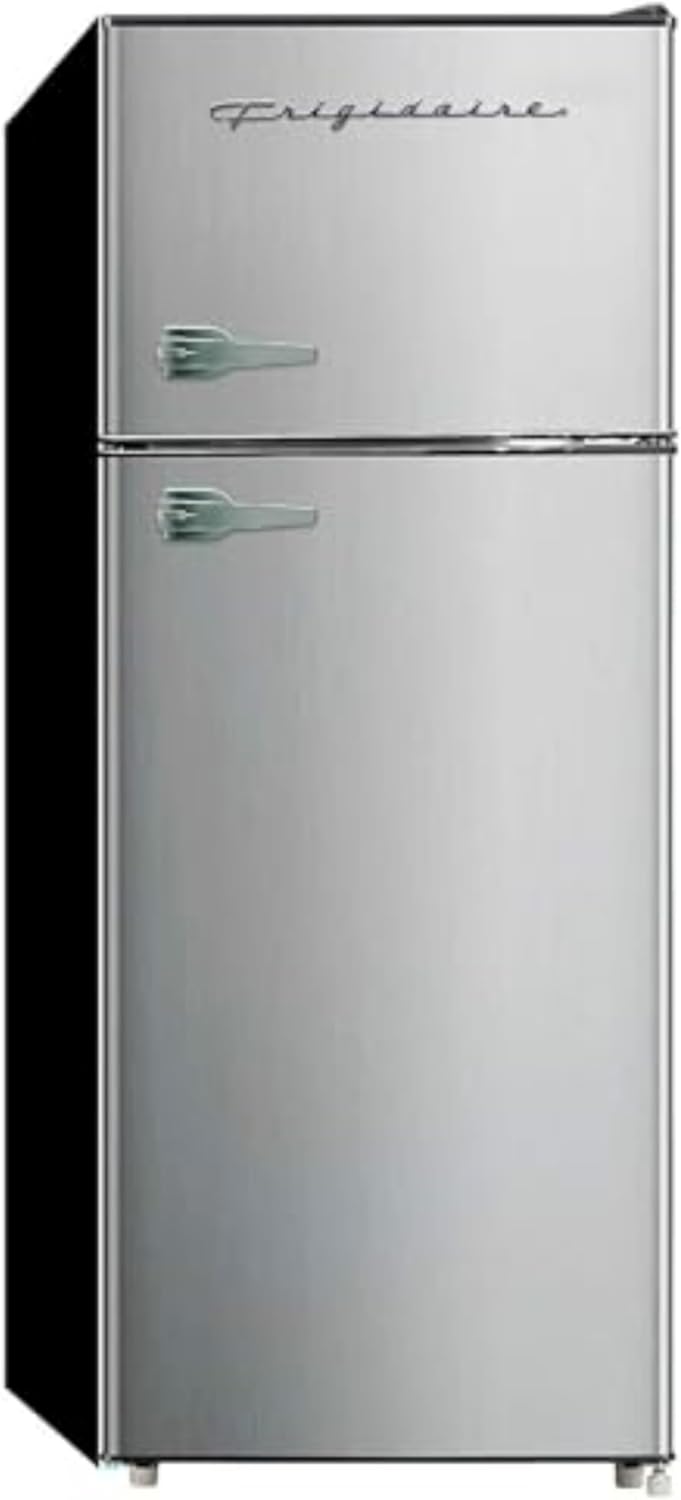
Top-Freezer: The American Classic
The traditional top-freezer has two vertical doors: freezer on top and refrigerator below. Top-freezer refrigerators are appreciated for their straightforward design and budget-friendly nature, and they're the most common model in American homes for decades.
With capacity between 11 and 18 cu. ft., they offer good balance between space and consumption, and models with the freezer on top tend to use the least energy.
Main advantages:
- Easy-access freezer at eye level
- Wide variety of models and prices ($600 to $1,600)
- Replacement parts widely available
- Independent operation of compartments
Ideal for: Families with young kids since the freezer stays accessible, and anyone who prefers traditional, reliable models.

Bottom-Freezer: Ergonomics First
Bottom-freezer refrigerators place the fresh food compartment at eye level, minimizing the need to bend down when accessing frequently used items. This design revolutionized the concept by flipping positions: fridge on top, freezer below.
Why bottom-freezer is more practical:
You open the fridge dozens of times daily for water, fruits, leftovers, and ingredients. The freezer gets used just a few times per week. In bottom-freezer models, your most-accessed items sit at eye level, eliminating constant bending.
Main advantages:
- Less physical effort in daily use
- More uniform fridge temperature
- Modern, sleek design
- Lower energy consumption (hot air rises, keeping fridge cold)
Considerations:
- Price 15-25% higher than equivalent top-freezer models
- Freezer less accessible for small children
- Requires bending to grab ice or frozen items
Ideal for: Adults who value comfort, seniors with mobility issues, childless couples, and anyone who cooks heavily with fresh ingredients.
Side-by-Side: Maximum Space and Organization
Side-by-side models have two vertical doors splitting space equally between fridge and freezer. They're the largest residential options at 18 to 25 cu. ft.
Many include water and ice dispensers in the external door, digital control panels, and even Wi-Fi connectivity for smartphone control.
Main advantages:
- Generous capacity for large families
- Superior organization with multiple compartments
- Simultaneous access to fridge and freezer
- Cold water dispenser without opening door
- Premium, impressive look
Considerations:
- High initial investment ($1,500 to $3,500)
- Width of 33-36 inches (won't fit all kitchens)
- Monthly consumption of 150-210 kWh
- Requires water line for dispenser
Ideal for: Large families (5+ people), frequent entertainers, spacious kitchens, and tech enthusiasts who value convenience.
French Door: Sophistication and Functionality
French door combines the best of both worlds: two upper doors for the fridge and one or two lower drawers for the freezer. It's the most modern and complete model.
With capacity above 18 cu. ft., they offer specialized compartments like humidity-controlled drawers, adjustable temperature zones, and LED lighting throughout.
Ideal for: Anyone seeking top-of-the-line refrigeration, gourmet and designer kitchens, and those who won't compromise on technology and design.
Frost-Free vs Manual Defrost: Which to Choose
The defrost system is one of the most important yet misunderstood criteria. The difference goes way beyond "forms ice or not."
How Frost-Free Works
Frost-free uses fans circulating cold air constantly, preventing moisture buildup on walls. Every 8-12 hours, an automatic heating system eliminates any residual ice formation.
Real everyday benefits:
- Zero defrosting maintenance
- Uniform temperature in all corners
- Food doesn't stick or dry out
- More usable space (no inches lost to ice)
- Better preservation of flavors and textures
Myths about frost-free:
Many people believe frost-free dries out food. This only happens when you store items without proper packaging. Use sealed containers or plastic wrap and the problem vanishes completely.
Energy consumption is practically equal to equivalent manual defrost models. Air circulation actually improves thermal efficiency.
Manual Defrost: When It Makes Sense
Manual defrost systems require you to turn off and defrost the freezer manually 2-3 times yearly.
Advantages:
- Price 20-30% lower than equivalent frost-free
- Slightly lower consumption (6-15 kWh/month)
- Fewer electronic components (more durability)
Disadvantages:
- Work of defrosting freezer every 6 months
- Lost usable space as ice accumulates
- Less stable temperature
Ideal for: Tight budgets, folks who don't mind periodic maintenance, or light freezer users.
Cycle Defrost: The Middle Ground
Cycle defrost systems automatically defrost the fridge but the freezer still forms ice and needs manual cleaning twice yearly.
When to consider: Only if budget is extremely limited or for occasional use (vacation home, home office).
Inverter Technology: Worth the Investment
Inverter technology is one of the most significant innovations in fridges over recent years. But what exactly does it do that justifies paying up to 20% more?
How Inverter Compressors Work
Conventional fridges use compressors that turn completely on and off. When temperature rises, the motor kicks on at 100% power until everything cools down. Then it shuts off. This cycle repeats dozens of times daily.
The digital inverter compressor intelligently varies its power and running speed according to the immediate cooling requirement, making 5 different operating cycles based on humidity levels and usage patterns.
Practical and Measurable Benefits
30-40% energy savings:
Studies show that inverter refrigerators can consume up to 30-40% less energy than traditional models. A conventional compressor consumes high energy spikes each time it kicks on. Inverter runs continuously at low speed, consuming less overall. In numbers: a conventional 14 cu. ft. fridge uses about 165 kWh/month. The same model with inverter uses just 105-120 kWh/month.
50% noise reduction:
The constant on-off of traditional compressors creates that characteristic "fridge motor" sound. Inverters operate continuously at low rotation, generating only 30-35 decibels—you barely notice it's running.
Food preserved longer:
Temperature oscillations accelerate food deterioration. Inverter maintains variation of just 1-2°C, while conventional models fluctuate 3-5°C. Result: your veggies last up to 7 days longer.
Superior durability:
Turning motors on and off causes mechanical wear. Inverter compressors have 30-50% longer lifespan with less maintenance need. Many manufacturers offer 10-year extended warranties on inverter compressors.
Worth the Extra Investment?
An inverter fridge costs $350 to $900 more than an equivalent conventional model. With savings of 60 kWh/month at $0.15, you recover the investment in 30 to 60 months.
Considering a fridge lasts 10-15 years, total savings can reach $2,400 to $3,600 over the appliance's lifetime.
When it's worth it:
- Families using the fridge heavily
- Remote workers who value silence
- Homes with high electric bills
- Planning to stay many years in the house
When it might not be worth it:
- Very tight budget right now
- Temporary housing (under 3 years)
- Occasional appliance use
Energy Efficiency: How to Cut Your Electric Bill
The ENERGY STAR label is your best friend when choosing an economical refrigerator. ENERGY STAR certified refrigerators are about 9% more energy efficient than models meeting federal minimum energy efficiency standards.
Understanding ENERGY STAR Rating
By properly recycling your old refrigerator and replacing it with a new ENERGY STAR certified refrigerator, you can save about $150 over the 12-year lifetime of the product.
The difference between ratings represents significant real-world consumption variations:
ENERGY STAR Certified: Consumes up to 30% less than standard models. Represents cutting-edge efficiency. Usually models with inverter and superior thermal insulation.
Standard Efficiency: Satisfactory efficiency baseline. Balanced consumption without special technologies.
Below Standard: Avoid if possible. Consumption can be up to 60% higher than ENERGY STAR, resulting in electric bills up to $48 higher monthly.
Rating | Monthly Usage | Monthly Cost | 10-Year Cost |
|---|---|---|---|
ENERGY STAR | 105 kWh | $15.75 | $1,890 |
Standard | 135 kWh | $20.25 | $2,430 |
Below Standard | 180 kWh | $27.00 | $3,240 |
Very Inefficient | 225+ kWh | $33.75+ | $4,050+ |
The $18 monthly difference between an ENERGY STAR model and a below-standard one represents $2,160 in 10 years—more than the price of a new fridge.
Tips to Maximize Savings
Besides choosing an efficient model, how you use it matters a lot:
Set temperature correctly: Most fridges work best with the refrigerator between 35-38°F and freezer between 0-5°F. Lower temps waste energy without extra benefit.
Keep door seals in good shape: A worn seal lets cold air escape, forcing the motor to work 20% harder. Test by closing a dollar bill in the door—it should hold with resistance.
Avoid putting hot food in: Wait for it to cool naturally to room temperature. A hot plate makes the fridge work overtime to compensate.
Organize for less opening: Keep daily-use items in easy-access positions. Each second with the door open wastes energy.
Defrost frozen food in the fridge: Instead of leaving on the counter, place frozen meats in the fridge the night before. The cold they release helps the fridge.

Interior Organization: What Really Matters
Two models with the same total capacity can have completely different usable space depending on interior design. Pay attention to these details.
Adjustable Shelves Are Essential
Fixed shelves limit what you can store. A model with shelves adjustable at multiple heights lets you fit everything from tall bottles to high cakes.
Look for models with at least 3 adjustment levels per shelf. This offers real flexibility to adapt as your needs change.
Shelf materials:
Tempered glass shelves beat wire ones. They're easier to clean, don't stain, and prevent spilled liquids from dripping to lower levels.
Specialized Compartments
Modern models include compartments designed for specific food types:
Crisper drawer with humidity control: Keeps greens and fruits fresh up to 10 days, versus 5-7 days in regular drawers. Adjustable humidity control lets you customize for delicate leaves or ethylene-releasing fruits.
Extra-cold compartment: Zone with temperature near 32°F, perfect for meats, deli items, and dairy. These foods last 40% longer than in the regular fridge.
Door with compartments for cans and bottles: Specific spaces for beer bottles, cans, and 2-liter bottles optimize space usage. Some models fit up to 12 organized cans.
LED lighting: Way beyond aesthetics, LED lights up all corners better, makes finding items easier, and consumes up to 80% less energy than traditional incandescent bulbs.
Freezer: Capacity and Dividers
Don't just look at total freezer capacity. The internal layout and dividers make all the difference in daily use.
Drawers and removable shelves: make organizing by categories easier (meats, ready-made frozen foods, ice) and prevent having to remove everything to find one item.
Freezer with handles and sliding baskets: improves access and reduces food waste forgotten in the back.
Recommended minimum capacity: the freezer should be at least 25% of total fridge capacity. In bottom-freezer models, this is usually better distributed.
If you're looking for the best laptops for students or checking out what is RAM, having a reliable fridge is just as essential as having quality tech gear. Just like choosing the right router for your home network, selecting the right refrigerator impacts your daily life quality.
Frequently Asked Questions
What's the ideal refrigerator size for my family?
For 1-2 people, go with 9-11 cu. ft. Families of 3-4 need 14-18 cu. ft. For 5+ people, choose models over 20 cu. ft. to comfortably store groceries without cramming everything in.
Is frost-free actually worth it?
Absolutely yes. Frost-free systems automatically eliminate ice buildup, eliminating manual defrosting. This saves time, prevents messy cleanup, and maintains more consistent temperatures for better food preservation.
How much electricity does a fridge use monthly?
Depends on size and efficiency. Small fridges use 60-90 kWh/month, medium ones 90-135 kWh/month, and large ones 135-210 kWh/month. Models with ENERGY STAR certification can save up to 40% compared to less efficient units.
What's the difference between top-freezer and bottom-freezer fridges?
In top-freezer models the freezer sits up top with the fridge below. Bottom-freezer is reversed: fridge on top, freezer below. Bottom-freezer is more ergonomic since daily-use items are at eye level instead of making you bend down constantly.
Do inverter compressor fridges really save energy?
Yes, inverter technology automatically adjusts compressor speed based on cooling needs, avoiding energy spikes. This cuts energy consumption by 30-40% versus conventional models while running quieter too.
Do I need to leave space around my refrigerator?
Definitely. Leave 4-6 inches on the sides, top, and back for proper ventilation. This ensures efficient operation, prevents motor overheating, and extends the appliance's lifespan significantly.
What's ENERGY STAR and why does it matter?
ENERGY STAR certification identifies fridges that meet strict efficiency standards. These models consume significantly less energy, resulting in lower utility bills and reduced environmental impact over their lifetime.
Conclusion
Choosing the right refrigerator goes way beyond price or looks. It's a decision that impacts your routine, energy consumption, food waste, and daily comfort for many years.
By considering proper capacity, fridge type, frost-free system, inverter technology, energy efficiency, and interior organization, you avoid regrets and make a smart investment.
If you made it this far, you already know:
👉 The best fridge isn't the most expensive—it's the one that perfectly fits your lifestyle.
Use this guide as a checklist before buying and transform your kitchen into a more practical, economical, and functional space.
Whether you're upgrading your home office setup, exploring how the internet works, or learning about what is VPN for security, choosing quality appliances like fridges is equally essential to creating a comfortable, efficient home environment. And don't forget that proper cable management applies to appliances too—keeping your kitchen organized behind the scenes matters just as much as what's inside your fridge.
Need more tech gear? Check out the latest smartphones, laptops, and smartwatches to complete your modern home setup.